
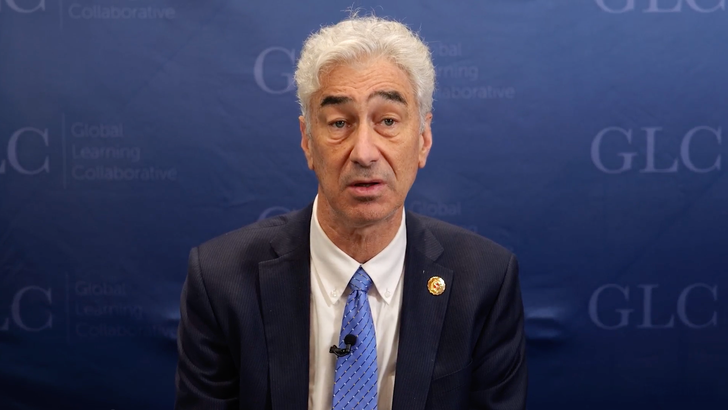
This video brief features Dr. Matthew Budoff reporting from AHA 2025 in New Orleans. He presents findings from the VESALIUS-REAL Global Burden Study, which assessed the incidence of stroke and myocardial infarction across diverse regions in patients at high risk of a first major atherosclerotic cardiovascular event (MACE). Dr. Budoff reviews the study’s design and geographic scope and offers insights into the global burden of atherosclerotic events in individuals without prior cardiovascular disease. He also highlights the clinical implications of these findings for guiding primary cardiovascular prevention strategies across varied populations.
Global Burden of Stroke and Myocardial Infarction in Patients at High Risk of First MACE: Insights From the VESALIUS-REAL Study

Transcript
Global Burden of Stroke and Myocardial Infarction in Patients at High Risk of First MACE: Insights From the VESALIUS-REAL Study
closeTranscript
Global Burden of Stroke and Myocardial Infarction in Patients at High Risk of First MACE: Insights From the VESALIUS-REAL Study
closeDr. Budoff:
Hi, my name is Matthew Budoff. I'm a professor of medicine at UCLA, and I'm here with you at the American Heart Association in New Orleans, Louisiana.
Today, I wanted to talk to you a little bit about the VESALIUS-REAL study. This was a study that looked at real-world evidence across many different countries around the world, incorporating over 1.1 million patients, to look at the risk of stroke and myocardial infarction rates in patients at high risk for first major atherosclerotic cardiovascular events. We incorporated patients with diabetes and other risk factors. We incorporated patients with established cardiovascular disease, peripheral arterial disease, and prior TIA or stroke, to look at the implementation of lipid-lowering therapies and LDL testing over the course of 5 years.
Looking at these patients across multiple different countries, we found about 50% of patients were not tested for LDL-C at all over at least 1 year. Of those patients that were tested, less than 50% were on any lipid-lowering therapy, including statins, and less than 5% were on any non-statin therapies. Only 1 in 5 patients around the globe achieved guideline-recommended LDL-C goals over the 1-year follow-up. We looked at incidence rates for myocardial infarction and stroke over 5 years from that index date when we put them into the study. Cumulative incident rates for myocardial infarction were 1% to about 5%; in the US, the incident rate for myocardial infarction was about 2%. And over the 5 years, the stroke risk ranged from about 3% to 13% for first stroke at 5 years after index event.
So think about this. We have patients who are high-risk, they're not getting tested for LDL, and even when they are getting tested, they're not getting to goal. Only 1 in 5 patients made it to their LDL-C goal during follow-up. So we have an incredible opportunity to optimize lipid management in this high-risk population to prevent myocardial infarctions, strokes, and of course, cardiovascular death.
With the emerging data that we have now from the VESALIUS-CV outcome study showing that we can reduce events by an additional 25% if we need to add additional therapies, like evolocumab, to statins, we can really make a big impact in our clinical practice. But we have to start with LDL testing, we have to move to statin therapy, and then, if their LDL is still above target guidelines, we need to implement non-statin treatments to help us get this burden of risk down.
So please join me in really maximizing testing and optimizing treatment in this very high-risk population.
I’d like to thank you for joining me, and I look forward to talking to you again. Take care.
Ready to Claim Your Credits?
You have attempts to pass this post-test. Take your time and review carefully before submitting.
Good luck!
Overview
Provider(s)/Educational Partner(s)

Today’s healthcare environment is constantly evolving and advances of medical science occur at an accelerating pace. CME/CE plays an important role in the clinical environment and is an essential element of physician training, learning, and improvement, thereby importantly contributing to optimal patient care. Since 2000, MEDCON’s mission is to deliver high quality within the world of medical education by creating forums like PACE-CME, organizing live meetings, and providing online education. We aim to stimulate the review, exchange, and assimilation of key scientific findings to improve patients’ health, to raise awareness of new science underlying various disease states, and to accelerate the translation of this information into clinical practice.Commercial Support
This activity is supported by an independent educational grant from Amgen, Inc.
videoEvolocumab in Patients at High Cardiovascular Risk Without Prior MI or Stroke: Primary Results of the VESALIUS-CV Trial
Show more
videoReal-World Impact of Evolocumab on MACE Reduction in ASCVD
Show more
videoPrimary Results of the VESALIUS-CV Trial: Evolocumab in Patients at High Cardiovascular Risk Without Prior MI or Stroke
Show more
Overview
This video brief features Dr. Matthew Budoff reporting from AHA 2025 in New Orleans. He presents findings from the VESALIUS-REAL Global Burden Study, which assessed the incidence of stroke and myocardial infarction across diverse regions in patients at high risk of a first major atherosclerotic cardiovascular event (MACE). Dr. Budoff reviews the study’s design and geographic scope and offers insights into the global burden of atherosclerotic events in individuals without prior cardiovascular disease. He also highlights the clinical implications of these findings for guiding primary cardiovascular prevention strategies across varied populations.
Provider(s)/Educational Partner(s)

Today’s healthcare environment is constantly evolving and advances of medical science occur at an accelerating pace. CME/CE plays an important role in the clinical environment and is an essential element of physician training, learning, and improvement, thereby importantly contributing to optimal patient care. Since 2000, MEDCON’s mission is to deliver high quality within the world of medical education by creating forums like PACE-CME, organizing live meetings, and providing online education. We aim to stimulate the review, exchange, and assimilation of key scientific findings to improve patients’ health, to raise awareness of new science underlying various disease states, and to accelerate the translation of this information into clinical practice.Commercial Support
This activity is supported by an independent educational grant from Amgen, Inc.
videoEvolocumab in Patients at High Cardiovascular Risk Without Prior MI or Stroke: Primary Results of the VESALIUS-CV Trial
Show more
videoReal-World Impact of Evolocumab on MACE Reduction in ASCVD
Show more
videoPrimary Results of the VESALIUS-CV Trial: Evolocumab in Patients at High Cardiovascular Risk Without Prior MI or Stroke
Show more
Title
Share on ReachMD
CloseProgram Chapters
Segment Chapters
Playlist:
Recommended
We’re glad to see you’re enjoying ReachMD…
but how about a more personalized experience?



